SERMON ON THE 27TH SUNDAY AFTER PENTECOST 

SERMON ON THE 27TH SUNDAY AFTER PENTECOST 

Archpriest Sergiy Baranov

The Solovetsky Monastery

10.12.2023


In the name of the Father, and of the Son, and of the Holy Spirit!

In today’s Gospel, we listened to a story about how the Lord healed a poor woman, who had suffered from a grave disease for a long time. The Lord freed her from this grave suffering, but the Jews, who surrounded Him, had become so hard-hearted that they did not rejoice at this, nor did they sympathize with that woman, who was suddenly relieved from that overwhelming burden of suffering. They judged the Lord instead. They judged the Lord because He violated the Sabbath, He healed on that day.

The Lord acts for those damaged people through their conscience. He admonishes them, touching their hardened conscience. All of a sudden, even their conscience comes to life and, as the Gospel says, they “were put to shame,”1 they were ashamed.  Suddenly, their conscience, that was almost dead, woke up, and they felt shame. Conscience is the voice of God in a person. Often, inside of a person, where almost everything that belongs to God is damaged, there is still a very thin voice of God, which acts through his or her conscience.  

Once, the teacher of St Symeon the New Theologian, St Symeon the Most Reverent, instructing his disciple, said the following, “Listen to the voice of conscience throughout your life and pray without ceasing, then you will succeed.” It seems to be the only thing that remains relatively not damaged, and meant to hear God. 

I am using the word “relatively” because only a few moments ago, during the Cherubic Hymn, the priest in the altar said the secret prayer, which has the following words, “purge me of a wicked conscience.”2 These words are horrifying because it turns out that our conscience, together with all the powers of our soul created by God, is damaged. It is damaged and perverted. This is why the priest says these words at the crowning moment of the Liturgy, “Lord, purge me of a wicked conscience.” It turns out that after the Fall, even this Divine power of conscience becomes damaged in people and satan can enter even this power of the human soul. He does not enter in some extraordinary way, in contradiction or in contrast not to draw our attention to him, but he does it gently and parasitizes on the gift of conscience. He does not contradict conscience, so the person will not turn away from him at once, but acts simultaneously with it, very close, step by step, and then perverts it slightly.   After the Fall, even basing on their conscience, people often make mistakes. Unfortunately, even this gift is damaged within us.  

Shortly before His Calvary, the Lord told His disciples the words that might seem very strange for many people, “Assuredly, I say to you that there are some standing here who will not taste death till they see the Kingdom of God present with power.”3 The contemporaries of Christ thought His second coming would be already in the first century, when the witnesses of His life, people who were close to Him, were still alive. Many Christians wonder about the words of Christ. In the Gospel, right after these words were said, the following event happened. The Lord takes three of His close disciples, whom He loved very much, ascends Mount Tabor together with them and transfigured before them in all of His glory. This is what the Lord says about, “Assuredly, I say to you that there are some standing here who will not taste death till they see the Kingdom of God present with power.” This was the Kingdom of God in its power, and the disciples saw it through the Holy Transfiguration on Holy Mount Tabor. They were in the Uncreated Light, in the abundance of Divine Grace, and this was the Kingdom of God present with power.  

The Venerable Symeon the New Theologian says responsible and, to an extent, horrible words to every one of us, “If you did not have your own transfiguration and did not meet the Lord in this life, then this meeting is very doubtful in the future life.” This life is given to us so we, having applied effort in fulfillment of the commandments, in the mystery of prayer, met our own transfiguration already in this life.  Without this transfiguration it will be difficult for us to enter the Kingdom of God after our death. Because we will not be suitable for the Kingdom of God. We will be a foreign body there, and the Kingdom of God will become hell for us.  

Our purpose is to transfigure everything already in this life and do this with the help of Divine Grace, through our Lord Jesus Christ. We should transfigure all perverted powers of our soul, including, or first of all, our conscience. Conscience transfigures only through the Grace of God. The things which are impossible with men are possible with God.4 Those who try to rely only on their effort, sincerity, stability, and feat, are wrong. They will stumble and acquire nothing. Everything is made by the Grace of God, which we acquire as per our Venerable Father Seraphim of Sarov. The purpose of a Christian life is in acquiring the Grace of God. Acquire it without ceasing.  This is the aim of a Christian life. It should not consist only of moral life, we should always and everywhere acquire the Grace of God. Father Seraphim lists many means, which help to acquire Divine Grace, but ends with these words, “However, prayer gives more Grace than anything else.” 

Glory to our God, always, now, and unto the ages of ages!

1 Lk. 13:17

2 “Look upon me Thy sinful and unprofitable servant, and purge my soul and heart of a wicked conscience…” (The Divine Liturgy of St John Chrysostom)

3 Mk. 9:1

4 Lk. 18:27

SERMON ON THE DAY OF ST JOHN CRYSOSTOM

SERMON ON THE DAY OF ST JOHN CRYSOSTOM

Archpriest Sergiy Baranov

St John of Kronstadt Cathedral of Gai

26.11.2023


In the name of the Father, and of the Son, and of the Holy Spirit!

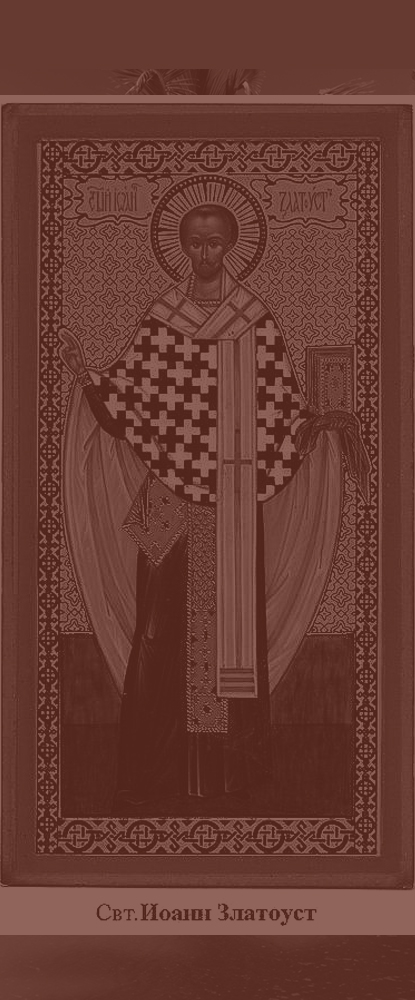
Today the Church commemorates St John Chrysostom. The mere epithet to his name “Chrysostom” is most suggestive. This man spoke blessedly, richly and understandably. The words he said penetrated the depth of the hearts of those who listened to him. He said and wrote a lot and there are many of his pastorals available to us now. These works of St John are full of moral content. This saint taught Christians morals. He spoke a lot about morals and denounced immorality at the same time, for which he suffered a lot. 

Back then, in the IV century, in the times of the Byzantine Emperor, when Constantinople was a Christian city and Byzantium was a Christian Empire, St John, being in his Patriarchal office, not only edified, but also denounced his flock. It may seem strange that in those times when Christianity flourished, a saint, a Patriarch, could suffer for his words, defending morality and denouncing immorality. His words were dangerous for him because he did not only reprove the lower strata of citizens, but also unmasked the immorality of the court, those people who were close to the Emperor. He even pointed to the immorality of the Empress, who officially was a Christian but in fact, desecrated this by her immoral behavior.  Moreover, she enticed the court away with her and the citizens looked at this behavior and learned bad from her. 

It is interesting that among many sermons on morality there certainly were those where St John Chrysostom spoke about non-judgment. However, what was he doing when he denounced sins? Unfortunately, he judged. We, with our narrow mind, can barely fathom this. We cannot understand how a person can preach about not judging and, as it seems to us, judge. We cannot get the point of it. Often, when we find ourselves thinking about this, we say, “Lord, how should we understand this? Not only St John Chrysostom, but also Jesus Christ Himself told us not to judge.” What relationship did He have with Pharisees throughout the Gospel? What did He do? He judged them. He was even angry with them. God Who is Love permits Himself to say, “Brood of vipers!1 How long shall I be with you?”2 Look, how tired He is by the morals of the Old Testament. 

How should we observe the commandment not to judge and not to welcome sin at the same time? We should not condone sin like they do in the previously Christian Europe. They say, “Do not judge. Do not judge various perversions, filth and shame.” When they say “do not judge” they even make reference to Christ, “The Lord said in the Gospel not to judge.” No one should dissever this phrase of its context, no one should dissever its meaning from the general meaning and then build their logic based on this meaning. No one should take Christ’s words “do not judge” and separate them from the fact that He judged evil deeds. Therefore, no one should have dissevered the phrase of St John when he said not to judge and judged even the Empress himself. How should we, who are poor and miserable, understand? How should we observe this commandment?   

Do you think I will explain it to you? Unfortunately, not. It cannot be explained as it is not here, (in your head), it is here (in your heart). Culture is not in your head, it is in your heart. A cultured person always knows the limits and the measure. What is the sense of delicacy? The sense of delicacy is the sense of measure.  I can say something to an extent, but what goes above it is already a sin. No Elder will ever be able to explain this measure with words to any disciple, unless the disciple’s spirit grows to an extent. The Spirit speaks directly to one’s heart, not to one’s head.    

I observed many uneducated illiterate old ladies who could only put a signature. I caught the time in the beginning of the 1990-s when they were still alive. They could only make a signature. They had never graduated from any university, they even had never gone to school. Nevertheless, they had a very sensible heart, very subtly did they sense measure with their heart, not with their mind. This is not good and this will be shameful.  Their heart determined decency and indecency. The heart is a very sensible organ. Our mind… Poor modern people! They are so proud of their mind! We fly to space, we discover atoms deeper and deeper… Poor people, we cannot agree among ourselves, but we fly to space… Strange people, we fly to space, we invented the nuclear bomb and do not have the wit to use it. Someone will certainly throw it. 

This measure of “judging and not judging,” the measure of spiritual behavior and spiritual notions is in one’s heart. But if the heart lives by passions, this passionate heart will not be sensible, it will be rude, vulgar, it will not perceive high notions, but will be oversaturated by vulgarity and passions. Therefore, the Holy Fathers worked on their hearts and their discernment and clairvoyance came from their refined heart, which perceived not only a quarter or an eighth of a tone, but a twelfth of it. These sounds do not exist for common earthly people at all. We do not hear them. However, the Holy Fathers lived in this subtle spiritual world, perceived and understood it. This is why they needed no explanations. They knew: this is the limit, I cannot go beyond it, but I can go up to this measure, here, to the right and to the left, but no further. Poor us with our rude hearts, we rush here and there, we have good intentions but the result is usually bad. No one of us consciously has bad intentions, does he? As Chernomyrdin used to say, “We wanted all the better but ended up as always.” This is our poor state. 

Thus, in order to allow oneself to speak about morality and immorality, like St John Chrysostom, one should have the heart and the mind of St John Chrysostom. If we come out and begin to imitate St John now, we will unleash another war or some nonsense. This is why, looking up at St John Chrysostom, we need to be cautious about our words. Who he is and who I am. What he allowed himself to say and what I can allow myself to say. I have many mistakes in comparison to him.  

One more detail of St John’s life. The Great Chrysostom, who has been venerated by the Church since the IV century, this teacher of the Church, ended his life in exile. Church clerics together with court rascals made a false accusation, framed up a case, gathered an unholy council, condemned him, removed him from the Patriarchal office and sent him into exile. He died on his way to the place of exile, in Kamani, Abkhazia.    We cannot understand this. We serve the liturgy of St John Chrysostom, he is the greatest teacher of the Church and when we remember this fact we cannot understand why. The Church represented by its not best people could not destroy him. Certainly, in his times, common people loved St John, they went out to the streets and cried, “Leave our Enlightener alone!” At the same time, there were those people in the Church who destroyed his good name, who deprived him of his post, title, and his mere life, as he died in exile.  Here rises a legitimate question: “How could it happen? How can this disgrace be in the Church of Christ? Didn’t the persecutors believe in God? Didn’t they believe in Jesus Christ? Didn’t they read the Gospel? Why did they persecute him?”  Moreover, there is one more question: “Why did God let all this be? The Church belongs to God. Why does He let every twelfth be a Judas?” 

Holiness reveals itself in contrast to dishonor. It is easy to be a pleasant and good person in a general mass of people, when this mass is calm, kind and stable. And how it is hard to remain, put up with, and forgive your enemies when there is disgrace around you. St John Chrysostom shone forth in contrast to this disgrace. This dishonor was humiliated and he was elevated in this contrast. 

Glory to our God, now and ever, and unto the ages of ages! 

Do not become surprised if you see any bad people, details or deeds in the Church or in society. Acidic, aggressive conditions are needed to reveal saints. Sometimes unchurched people come up to a priest and ask, “Why do you have so many bad people, priests in particular?” Sometimes I want to answer such zealots of piety, “Listen, we do lack good priests. Come and be one of them. We lack priests. Good and bad ones. The situation is catastrophic. You have a good disposition, you are all burning with eagerness. Perhaps, you should try.” He does not want this. Do you know why? Because the position of a priest imposes obligations on him. If people look calmly at common people, a priest is always as if under a microscope. People forgive and even do not pay any attention to some things, which common people do, but they scrutinize a priest in contrast and ask, “How could you do that?” This is why being a priest is very responsible; people always scrutinize you.  You cannot permit yourself the things a common person can. Moreover, a priest’s family, his children, also share this responsibility. Poor them, they bear such a responsibility! “Let it be you.” “No, I don’t want to.” It is clear that you don’t. Because already tomorrow people will say that you are a bad priest. Just try to bear this highness of St John Chrysostom. If he was persecuted and died in exile, what will happen to you? 

Thank you for listening. 

1 Mt. 3:7

2 Mt. 17:17

SOMEBODY TOUCHED ME

SOMEBODY TOUCHED ME

Archpriest Sergiy Baranov

Holy Trinity Cathedral, Iveron monastery of Orsk

November 11, 2023


In the Name of the Father, and of the Son, and of the Holy Spirit!

In today’s Gospel, we read how the father of a dying daughter met the Lord and asked Him to come and heal his daughter. When our Lord was on his way, the following event happened. There was a woman who had been suffering from a flow of blood for many years. As it is written in the Gospel, she “spent all her livelihood on physicians”1 hoping to be healed. So her livelihood was spent, but she was not healed. It was her last hope. She somehow squeezed  through this crowd to touch “the hem of His garment.”2 She said to herself, “If only I may touch His garment, I shall be made well.”3 Suddenly the Lord, Who was surrounded by a crowd of people, stopped and said these words, strange for everybody, “Who touched Me?”4 The Apostle Peter said, “Master, the multitudes throng and press You, and You say, ‘Who touched Me?’”5 And God says, “Somebody touched Me, for I perceived power going out from Me.”6 This power healed the poor woman immediately. This power could heal in an instant but doctors had not been able to for many years. She was almost desperate to find a doctor. 

Look, I want to draw your attention to the fact that this power is quite tangible and God perceived power going out from Him. The sick woman could definitely feel how this power entered her. This is Divine grace and it is not an illusion. It is very precise and tangible and you live through it not like “somehow” or “maybe” but you experience it rather definitely, precisely. Divine grace indeed. All other emotional feelings are experienced in a quite vague and complicated way, they make us think a lot, they distract our mind. When God does something, He does it precisely, shortly, simply and tangibly.  

Once, St. Gregory Palamas argued with a theological theoretic, Varlaam. It happened in Greece. Varlaam had profound knowledge but he did not have Divine grace. Knowledge without Divine grace can make you feel superior and get crazy. So this self-centred theologian came to Athos and communicated with the Athonite monks. They told him in simple words how they were living there being in Divine grace. They told him that they were living in the Uncreated Light, that they could see this light, it went through them and this light was tangible enough and real. And this—in old Slavonic language “витийствующий” cunning (old English), which can be translated to modern Russian as “мудрствующий от своего ума” “self-wise” (modern English) – theologian without any understanding of what the Athonites were talking about, started laughing at them. “What Uncreated light? What Divine grace?” Our Lord is so transcendent and inconceivable. What can you experience there, what light, what Divine grace?” Well, maybe he could have humbled himself a little before these Holy Fathers and their way of living.  Well, maybe he could have compared his life to their life at least. He lived in a capital, he was favoured by the Emperor, he was not hungry nor cold, he was in honour and had all the privileges of a man of science.  He could have compared himself to them and their way of living. All their lives are dedicated to Lord only, they refused things of this world, they put them apart. Only the Lord.  Can you imagine this? All their power is focused on God only. Nothing can distract them, they are focused on God only. And how could you argue with them, poor man. Your theory was just beating around the bush. But them, they concentrate straight on the Lord. Not only did you argue with them, but you also dared to mock them. And he started to laugh, “What Uncreated Light? Is this a vision about an atmospheric phenomenon?” Or what arguments did he make there?  

St Gregory Palamas, an Athonite monk, left Athos, silence and dedication, for Thessaloniki to have a discussion with this heretic, who was blaspheming Divine grace. There are these words in the Gospel when the Lord says, “Therefore I say to you, every sin and blasphemy will be forgiven men, but the blasphemy against the Spirit will not be forgiven men.”7 “Every sin will be forgiven” means that you will be forgiven after proper repentance. So, St. Palamas left Athos to overwhelm this blasphemer of Divine grace. And he managed this. He held a Church Council and proved that Athonite monks, being in Divine grace immensely, being in contemplation, could see God’s light, which the Apostles saw on Mount Tabor when the Lord’s Transfiguration happened. They were all in it, this light was not only outside but they were penetrated by it from inside as well, this light did not have any direction and everything around was immersed in this light. This way the Apostles lived through God’s Light, this way the Athonites lived through the Uncreated Light. Their sincerity, repentance and steady spiritual life of many years helped them to live this way. They were immersed in this light when contemplating. 

Well, the word “see” maybe is not a correct one to describe this light because we can see only what is in front of us. But the Uncreated Light, when it enlightens a person, shines both outside and inside. It penetrates everything around and you stop realising these terms where everything is different for you now. 

However, I want to say something else, something responsible. Divine grace is very tangible and existential. It acts not “somehow” but in a very precise way. But how can we not confuse the action of Divine grace to our emotional feelings and some thrills? We know many examples in Church history when people could not differentiate demons’ influence from the action of Divine grace. They perceived evil action as Divine one. This way they were impaired and defeated by evil. How can we differentiate Divine grace from emotional thrills, which are imposed, first, by satan and then by ourselves—we generate and imagine it on our own from the very beginning.

I believe Apostle Paul would answer this question better considering that he lived through Divine grace in some tremendous way—he was taken up to the third Heaven. The Lord, as He desired, according to His Divine Providence, took a fallen, sinful and quite material man to Heaven. This man saw tremendous things there which he could not even describe. He says, “I saw something, but I cannot even say what I saw there. I heard something but I cannot say what I heard because all of it was non-earthy, beyond our understanding.”

Well, this man acquired tremendous Divine grace, it was an incredible rise to Heaven, and look at his first reaction, feeling and impression. He says, “The Lord was seen after His Resurrection by many Apostles or one by one, or by all together and—he said here the key phrase – “Then last of all, He was seen by me also, as by one born out of due time.”8 Not only were these words based on the fact that he was a cruel person, but he also asked the Sanhedrim to give him a paper which would allow him to go around the world and search for Christians, torture and kill them. It was not the only reason why he was saying that he was a “great monster.” All Holy Fathers who experienced special Divine grace claimed the same thing. They considered themselves to be monsters in contrast with Divine grace. If I go to some den of drug addicts, alcoholics or murderers, I will probably look nice in this place, won’t I? But if I am in Divine grace that is the purest light, in contrast to it I will be the darkest gloom. 

Therefore, this is the best tool, point or attribute to understand what you do deal with—Divine grace or your own feelings or devil. When Divine grace comes, you consider yourself a real monster in contrast with the purity and sacrality of God’s grace. You cannot feel it in a different way. The Old Testament Holy Fathers, New Testament Holy Fathers fell down on their knees and cried in tears, “Lord, to me, the monster, You came.” They could not hold their tears back from the feeling of love and shame as well.

On the contrary, if you experience another condition like, “Finally. I have been practising the Jesus prayer for half of a year. Finally, God came!” Even the Schemanun here laughs. God, deliver us from evil. If something comes to you, and you do not consider yourself monster in contrast to it, but you feel worthy of God, “Yes, I worked sincerely, I did prostrations, I prayed, I donated to charity, I did everything and it happened finally” – that is it, you are at the very bottom. Moreover, it is even worse—you are below zero, a minus. It is impossible to experience different feelings because you are just filth. Try to remember your confession. Or try to remember not just “one confession” but all of them. Every time, from one confession to another, we do the same sins, the same sins—filth, stench and lie. Well, how we should feel if Divine grace comes indeed. We should fall down and close our eyes, bury our heads in our hands as Moses and Elijah the Prophet did.

Once on Athos, there was a story. A devil, who pretended to be an angel, knocked at a monk’s door. The monk opened the door and the devil, who pretended to be an angel, said, “Father Porphyrius, your prayer reached God and He sent me to take you to Heaven.”  To which this spiritually simple man, this childish soul—childish here means mildness, simplicity but not stupidity—so, he answered immediately, he did not even get that it was devil, he answered, “Oh, sorry, but it is not me. You should go to John’s cell, he is a real holy man but you are mistaken with my cell” – he said it sincerely, from the heart; he could not even understand that it was the devil because he was very simple and pure. His purity of heart immediately realised that it was not him to whom He may come, this cell is wrong. “You need that cell which is two cells further— a holy man lives there but me, I barely did my prayer rule, Lord have mercy on me.” 

We should not blaspheme Divine grace with our imagined feelings, which were created by our ignorance and vanity. We should have a reverent and serious attitude to it and be very careful. At the same time, we should not bring Divine grace to shame when it comes. How can we do that? Cry. 

Glory to God, both now and ever, and unto the ages of ages!

1Luke.8:43

2Luke.8:44

3Mat.9:21

4Luke.8:45

5Luke.8:45

6Luke.8:46

7Mat.12:31

81Cor.15:8

ABOUT A WISE PARENT

ABOUT A WISE PARENT

Archpriest Sergiy Baranov

Holy Trinity Cathedral, Iveron Monastery of Orsk

12.11.2023

In the name of the Father, and of the Son, and of the Holy Spirit!

In today’s Gospel, we heard about how the Lord healed a demon-possessed man. The man had suffered from this great sorrow for years. He was not simply a demon-possessed person but, as the Gospel says, there was a legion of demons in him and they tortured him a lot.   It is also said in the Gospel that people tried to bind him with chains and shackles, so he did not wander and hurt himself against the rocks and tear his body; they tried to put some clothes on him, but he tore everything apart. Or rather, it was not him, who tore, but the demonic power that did it. So, this man wandered about those deserted lands, naked, frozen and hungry. 

There was a touching moment there. Driving these demons out, the Lord entered into a conversation with this demonic power. The demons told him, “We are a legion.”1 Then they, the demons, begged the Lord that He would not command them to go out into the abyss. Look, what a touching moment it is. God answers the prayer of the demons. They ask Him and He answers even the prayer of demons and does not let them go into the abyss.  They say, “A herd of many swine is feeding here, permit us to enter them.” And the Lord permitted them to enter the pigs. What a touching moment! Demons pray and the Lord answers the prayer of demons. 

Every one of us standing here, who pray occasionally, from time to time, from sorrow to sorrow, from request to request, every one of us can become confused in our heart due to our spiritual inexperience and unwisely say, “The Lord hears even demons and answers their supplication. Why doesn’t the Lord answer my requests, even in emergencies? There were so many cases in my spiritual life, when I asked, ‘Lord, help me! Everything is bad. The situation is critical’ but it seems to me God was not by my side at those moments and did not answer me.” Look what happens to that request of the demons then. The Lord says, “Alright, let it be as you ask. If you want to enter the swine, you are welcome, do it.” But it changes nothing for the demons. They enter the swineherd, drive it mad and it runs violently down the steep place into the lake.  The Lord’s answer to their request and His compassion changes nothing for the demons, as they were demons, so they remained, nothing changes their damage.  

Therefore, we should apply a reciprocal change of our nature to every of Lord’s answer to our requests. We need to change our nature. “Metanoia” is a Greek word for “change,” in Russian it is “repentance.” “Metanoia” is a Greek word, which means the change of consciousness. When people’s consciousness changes, they begin to behave correctly in a spiritual way.  First, they begin to pray correctly, ask correctly, accept correctly and preserve this state correctly. If the Lord answered every one of our stupid and unwise requests (even if it seems to us that we are asking for the good) because of our imperfect mind, soul and heart, fretted with sin, this request for the good will repeat the situation in the future. The Lord says, “Well, you are asking Me. Let it be this way.” However, the result might be negative, because we do not ask for the good. As the Holy Apostle says, “You ask and do not receive.”2 Why? Because we do not ask for the good.   

What is good? It is a very relevant notion. There is good from the point of view of our earthly being. It seems to us that the good is wellbeing, stability, and peace. Meanwhile, spiritual good is often different. The Lord tells the following terrifying words to His disciples, “If you want to be my disciple, take up your cross and follow me.”3 And the Gospel says after this, “From that time many people went back and walked with Him no more.”4 Because they did not see the good in the theme of the cross. They lived through the earthly mindset: it is good when everything is alright in your family, everyone is healthy, you have a job, stability, money and everyone feels good. For us, earthly people, this is good. However, the Lord always looks from the point of eternity. He sees that when our earthly being is good, our heart becomes dry.  Our heart begins to think about life. It is a mere dot, a dot on the line of life. What is our life? It flares up and blows out. Someone might think a hundred years is a lot. Ask elderly people, “Is it a lot?” They would say, “As if I was born yesterday.” This is the way life flashes by. When we try to put all the meaning into this small dot, we make a mistake. While the Lord does not look at this dot, He takes care of us considering eternity. And He understands, if we concentrate all our attention, life and values only at this point, we will make a mistake and this will cause us harm. This is why the Lord lets sorrows be, so we can realize how everything is unstable and unreliable. It seems, you have ceased stability, but sorrow comes from where you do not expect it to come. It resembles a house, which is built on the sand, or a rich man who gathered his wellness and thinks he will own it forever. He does not even suppose that someone is going to rob him at this very moment. He does not even realize that life circumstances, permitted by God, have come to meet him now when he thinks he has made provisions for everything. He calculated his stability, but does not even suspect that sorrow is coming to him at this very moment and this sorrow is a part of God’s providence and this providence saves us in the perspective, in the future.   

People, wake up! Everything is unreliable, everything is very unstable. Live considering eternity. Live looking into eternity. Do not stop your whole mind and thought here, at this point. This point will not exist tomorrow. Perhaps, this point is filled with sorrow or joy, but tomorrow there will be none of them, neither sorrow nor joy. This is why you bear your sorrow with gratitude to God. And bear your happiness remembering it is not the main thing and it does not make the whole sense. Everything passes, and this will pass too. 

Those people who know what sorrow is, become wise for eternity. While people who do not know sorrow, remain wise only in this short life. Tomorrow there will not be this life. We, Christians, work considering the perspective, we work for the future life. This is why we go to church, pray, observe the commandments, save the relationship with God, no matter if we feel bad or not, if we can pray or not, if it seems to us that the Lord abandoned us. Sometimes it seems that you are the most sorrowful person in the world, because some of your friends are well or stable. “Why are my things bad?” you think. Perhaps, God is kissing and embracing you at this very moment because He loves you considering the perspective. 

Lord Jesus Christ…

An earthly parent, who is unwise, pampers his child. He feels pity for him or her today, at this moment, and he does not think that this spoiled child will suffer from his spoiled character in the future. But the earthly parent, limited by his earthly “love,” loves him only now and does not understand that now he must be strict, come over the tears of his child, so he will be wise, hardworking, obedient and happy in the future.   

A wise parent keeps up with the immediate sorrow of his child with bleeding heart and loves considering the perspective. While an unwise one might love himself in this child. He cannot overcome the discomfort caused by the tears and immediate sorrow of his child and does not think what will happen to him next. 

Glory to our God, always, now and unto the ages of ages!

1Lk. 8:30

2Jm. 4:3

3Mt. 16:24, Mk. 8:34, Mk. 10:21, Lk. 9:23…

4Jn 6:66

UNLESS THE LORD BUILDS THE HOUSE

Unless the LORD builds the house…1 

Archpriest Sergiy Baranov

St. John of Kronstadt Cathedral of Gai

October 29, 2023


In the Name of the Father, and of the Son, and of the Holy Spirit!

Today the Church commemorates the holy centurion Longinus. He was one of the soldiers who crucified our Lord. They were crucifying Jesus with a sense of right and justice. They were sincere. All of a sudden, this tormentor, this soldier, this cold hearted man of war who served in the army and did it really proficiently. It is said that Roman soldiers could crucify skilfully and aptly, they could do it in an incredibly precise way. They defended their motherland not only on battlefields, but when it was an internal conflict they were devoted to their imperator until the end.

This soldier, who had been serving in the army righteously just recently, changed his attitude all at once. Immediately, when Jesus was dying on the cross, writhing with pain and agony, when Jesus was crying on the cross. He cried out these words, “Eloi, Eloi, lama sabachthani?” which is translated, “My God, My God, why have You forsaken Me?”2 The Lord died and the earth trembled, nature itself showed Who had just died and what had happened. At this moment, this soldier experienced a great change, it was like everything turned upside down. One minute ago, he was a tormentor but in a moment he turned into a disciple of Christ, devoted to God until death. 

Sometimes I try to put myself in this time and place. How would I live through the coming of God? Unfortunately or maybe fortunately. Unfortunately, and I do speak sincerely, maybe I would not recognise God as well. Imagine, a man lives in a society for thirty, thirty-three years, he is among us, he looks like us, he does not really stand out. Someone knows Him personally, someone knows His family or comes across Him. And all of a sudden this man says, “I am the Son of God”. Well, try to put yourselves at this time span. What were Israelites saying, in what way did they think, how did they perceive it? “He is crazy. He is insane.” Suddenly He became superior and proclaimed Himself as the Son of God. So, they think earthly, objectively and act in this way as well. It is a great blasphemy when a man proclaims himself as the Son of God, equal to Our Heavenly Father because He says these words, “I and My Father are one.”3 Blasphemy, sacrilege. In those severe times, when there were really strict rules, you could be killed immediately for this. He blasphemes, He dishonours God, He dares to compare Himself with God, He joins Himself with God and says, “I and My Father are one.” 

Two thousand years passed and now Christianity is established in the whole world, and it is a part of world culture indeed. But back then, the Israelites had the Old Testament culture and it was a really earthy kind of culture. Look at those morals: An eye for an eye and a tooth for a tooth.4 So called human fairness. But suddenly this Man comes and proclaims Himself as the Son of God, and now their world perception is upside down. “But I tell you not to resist an evil person. But whoever slaps you on your right cheek, turn the other to him also.”5 People cannot understand, cannot swallow it. Not only do they not understand it but feel angry about it, they rebel. They rebel to such an extent that they crucify Lord at the end. But having already crucified Him, they could not calm down, and, staying there under the cross, they were spitting at Him. This Man was writhing with pain and agony so let Him just die but even at that moment, but no…

We can understand them in an earthly way. This Man blasphemes, He calls Himself as Son of God. But how can we understand Him in a different way, if all these events were supernatural? What kind of man should there be to see the humankind in Him and that this humankind is full of God? So I can see humankind but I cannot see God. The same is now. The whole universe is filled with God, the whole universe is filled with the Wisdom of God but we cannot see it. Sometimes we cannot see His wisdom. Sometimes we say to a non-believer who cannot see spiritual at all, “Look how our universe is balanced, how it is built, how precise it is, like the most complicated watch mechanism.” Someone created this gear wheel, started it and calculated the number of gear teeth to make it move, not to cumber but to push this mechanism. Our space is an extremely complicated being. There should be an Architect, Who…

How can something be created? First, you conjure up an idea in your head. Then this idea should be implemented into a project. Then workers build the construction according to this project and follow it precisely. If they deviate from the project, there will be cracks.  Or even worse, it will be ruined. So, there is an Architect of all this world harmony. 

You say it to a non-believer but he says, “It is just nature.” I ask immediately, “But nature, is it who or what?” If nature is only “what” then “what” cannot create wisdom, it can only be created by “who.” How can we understand it? There are half of the people who are from the period of the Soviet Union. We were like insane at that time, as God said, “Hearing you will hear and shall not understand, and seeing you will see and not perceive.”6 We looked at obvious things and understood nothing at all. Israeli people looked at Christ and saw nothing. 

You know, I do not blaspheme, but as a sinful man, I understand the Israeli people. Unfortunately, if I put myself in that time span, I would see nothing as well. Or even worse, I would be among these tormentors and with a sense of righteous anger would think: how can this Man blaspheme God! I could be one of them. 

What should there be to be able to see God? What do we need now to see God?

Someone mightsay, “We need the simplicity of Apostles. Clerisy was fastuous about their knowledge, Pharisees, Sadducees, but God came to simple Apostles and their simple heart accepted the Gospel easily.” But again I doubt it. How many dumb things do we do in our life because of our simplicity? We do dumb things with this simplicity of our soul. I think it is not only simplicity that we need here. Maybe simplicity is just a small detail. It has been thirty years already that I am a priest and I’ve come to this conclusion “Unless the LORD does, no one can do nothing. You may read all religious books and even learn the Gospel by heart. You will learn the text but will not be able to understand it. Or even worse, you will distort the meaning of it and understand it as you wish. It will be your own Gospel, not God but your own god, whom you create yourself. If God does not touch your heart and mind, you will understand nothing. Or even worse, you will get it wrong. 

Once a woman told me, “Father Sergiy, it is so difficult to save your soul if you do not understand where the truth is.” I said, “It is not that scary. The scariest thing ever is when you know where the truth is and you go there as an armoured train, but the truth is not there in the end.” When you are sure where the truth is, but it is not actually there, then you are mistaken. “Do not put your trust in princes, nor in a son of man, in whom there is no help.”7 However, the most important thing is not to trust yourself. Do not trust your mind and your heart. Do not trust even your sincereness.  Do not trust your repentance. All of these are distorted by sin. “Unless the LORD builds the house, they labour in vain to build it.” If God does not touch our mind, we will not understand anything. So put your mind to the background.  I do not want to say that you should switch it off at all, God gave it to us for some reason. We should understand that we use our brain for quite earthy reasons: how to calculate the family budget, work, and bring up children. But in spiritual life we face very subtle things. The wisest disciple is not the one who learns something by himself but the one who seeks a teacher. Our teacher is God. Jesus, Jesus, enlighten my mind. I think that I understand everything but in fact, after all, I can see that I understand nothing and I ruined everything again. 

What happened with centurion Longinus? Did he see something? We may say that he saw how nature trembled. But what, had no one seen this natural phenomenon at that time before? So, it was not about natural phenomenon. For some obscure reason, in this crowd of people, God chose this centurion and touched his heart. All of a sudden, his spiritual eyes were opened and he started to see. 

One of the most readable prayers in Church is “O Heavenly King” which is addressed to the Holy Spirit. O Heavenly King, – we ask, – come and dwell in us,
and cleanse us of all impurity, and save our souls, o Good One. The Holy Spirit enlightens us, He saves us. It is not us who save, it is not us who enlighten. We are enlightened not by reading or studying but by the Holy Spirit. 

Look how humbly the leper speaks in the Gospel. He comes and says these wonderful words. These words could not be made up and I am saying this for those who think that the Gospel was written intentionally. So the leper does not come to the Lord and say, “Heal me.” But how does he say it? “Lord, if You are willing, You can make me clean.”8 Look at this amazing humbleness. Not “Heal me” (Father Sergiy is shaking his fists). Very often, we come, write notes and demand from God, “Heal me, heal.” Once father George told me someone gave him a soul-paper about selling a flat. In a week this person came back, “No one even called!” You might have been sleeping all this week, father George. Look at the attitude which is completely different, “If You want, You may heal me.” Lord, if You are willing, You can solve the problem with my flat. 

We do not properly understand our going to Church. That is great! I came to church. That is great! I got faith. I started keeping to the commandments of God.  But it is not you! If not God Who touched your heart, you would go on walking about Gai and walk past church, you would not even look towards our temple. So God does something with us. When you do understand that it is not your merit but it is the mercy of the Lord that He chose you among millions of people, that is what happened to Longinus. In this case, you experience some affection, to tears, and there is no place for ignorance and vanity. “Thank you Lord, You are dragging me by the ears, You are dragging me and I am yet resisting. God, let me come next Sunday?” “But I invite you today.” “I have guests today, let me come next Sunday.” Look what He says next, “All right. Let it be next Sunday. But next Sunday we are going to have something else again. 

The allegory of God and us, insane children, is the father of a prodigal son. He is not just sitting and waiting. Look, He cannot even wait, He leaves house, they tell Him, “Look, your ragged son, who drank himself broke, is coming. Not only did he drink himself broke, but he undermined your reputation because everybody knows whose son he is. And he defames your name, humiliates it. And this… piece of crap is coming back.” The Father cannot wait and He heads toward his son. Only then the son comes to himself and says, “I am no longer worthy to be called your son. Make me like one of your hired servants.”9 “If You are willing, You can make me clean.”

It was a miracle what happened to Longinus. But it was not the merit of Longinus, it was the great mercy of the Lord. Each of us experienced this miracle—we wandered to church. But it was not for our merit, it was the great mercy of the Lord. We came but we behave inappropriately. But He bears, He bears and heads toward us. Glory to Him, now and ever, and unto the ages of ages. Amen!

1 Ps.126:1

2 Mk.15:34

3 Jn.10:30

4 Mt.5:38

5 Mt.5:39

6 Mt.13:14

7 Ps.145:3

8 Mt.8:2

9 Luke.15:19

SINCERE REPENTANCE

SINCERE REPENTANCE

Archpriest Sergiy Baranov

Holy Trinity Cathedral, Iveron Monastery

October 23, 2023


“God, give us sincere repentance” – these are the words in our prayers to God. Sincere repentance. It is seemingly so obvious to us. Repentance is such an explicit process. I am repenting. Apparently, the Holy Fathers emphasized in their prayers that a sin penetrates into us so deeply that even repentance could be insincere. It seems that we do repent, and at the same time, we start admiring ourselves simultaneously, the way we repent. It is like a theatre all the time, which we look at and perform for people. Sometimes we even try to deceive God. We always play theatre. Repentance is a subtle process and it will be seemingly blasphemous to play a double game here or be insincere. However, we can be hypocrites even here, when repenting. When we repent with tears, groaning and hand-wringing, we manage somehow to be hypocrites again looking at ourselves from the side and assessing how we look like. It sounds horrible but sometimes we are even pleased with ourselves.

I often give you this example of avoiding insincere repentance. How can we avoid insincere repentance and hypocrisy all together in our spiritual life? Remember once I gave you an example of one brother who entered the room where all brothers were and they started to praise him. He entered in silence and went out in silence as well. One brother could not hold back, ran after him and said, “Why did not you start to argue when everybody was praising you?” He says, “If I had paid attention to it I would have interacted with vanity. And maybe I would have had a contradiction and let it go into me, and one day it could have touched my heart.”

In the Old Patericon, one Father gives advice to his disciple who asks, “What should I do to find and take a middle course so as not to stagger and sully at the end?” And the Father gives him an example with decedents on a cemetery. He says, “Today go and swear at the decedents.” Next day, “Go and praise them.” Then he asks, “When you were swearing at them, did they answer you anything?” “No.” “When you were praising them, did they answer you anything?” “No, they are decedents.” There should be no interaction at all.

So, when we try to repent sincerely, our repentance should be simple. As God says,  “But let your “Yes” be “Yes,”  and your “No,” “No.” For whatever is more than these is from the evil one.”1 The evil intervene even into our repentance and start.

Sometimes there could be a question like how I may check if my repentance is sincere or not, if my repentance is from the Holy Spirit or evil, who is making me stagger from despair repentance to the vain one. Hither and thither. Now I have a despair repentance and close to give up. Then I have a vanity repentance — ah, how repentant I am, how sincere I am, I cry about my sins. Ugh, disgusting! How to find out if our repentance is from the Holy Spirit or not, from God or evil? Evil likes to repent with us as well, it likes to pray with us, it likes to keep the commandments with us, it likes to follow spiritual life with us, it likes asceticism a lot and it always adds some vanity everywhere. How to find out if we are inspired by God or by satan?

God is perfect. He is perfect and simple. God is very simple and this is His perfection. If He were complicated, He would never be perfect. You may add something to any complexity or detract from it.  So when God comes — in prayer, in repentance — He comes with great simplicity, which is actually His essence. Then you do not feel confusion, you feel great simplicity. And repentance is very simple and short. God, I am filth and that is it. There should be nothing else. Everything is simple and short and clear consequently. If you want to explain something in a clear way, you need to think of simple and understandable word. If you want to confuse someone, speak in a complicated way.

When God comes, you feel God’s presence as something simple, so it is all clear and definite. Satan always brings complexity. And it confuses us. This is why when we do the holy action like repentance, we start to stagger from despair to vanity. Even this holy action.

The feature of satan is complexity. Complexity of thoughts, feelings and mind. God comes in a simple, clear and definite way.

God, give us sincere repentance. Because even our repentance, seemingly the holy action, holy feeling, can be filthy, bad and unpleasant if it is mixed with vanity and if we start playing the theatre. We deceive ourselves this way, we deceive others, we play this role of repentant victim, we walk and play this theatre. We even try to deceive God, Who is the Reader of the human heart, Who knows our hearts better than us. We do not know ourselves but God does.

God, forgive me.

Glory to God, both now and ever, and unto the ages of ages!

1 Mt.5:37


IS IT POSSIBLE TO BECOME GOD WITHOUT GOD?

IS IT POSSIBLE TO BECOME GOD WITHOUT GOD?

Archpriest Sergiy Baranov

Holy Trinity Cathedral. Iveron Monastery of Orsk

22.10.2023


In the name of the Father, and of the Son, and of the Holy Spirit!

What is the meaning of human life? Why did the Lord create such a beautiful, complicated and genius creature? What were we born for? What do we live for? 

If eternal life is not part of peoples’ life meaning, then any meanings crush against the point of death. No matter how our meanings are great, wise, and genius, they will all crush against the point of death, turn into ashes and become nothing. The greatest meaning crushes against death and becomes ashes and dust. The wind blows and nothing remains. If there is no eternal life in one’s life reason, nothing makes sense. God created a human for eternity, not for an instant moment. Even a hundred years seems like a lot to us. Look back those of you who are in your eighties. Is it a lot? Like a wink! As if there was nothing. Young people stand here. One day you will look back and say, “It feels as if I haven’t lived yet.” What is the point of this instant in eternity if it does not pass into eternity? Absolutely no point at all. All meanings fall to pieces. 

Someone says, “I live to give life to other people.” You give life to a creature who will face the same question, “What was I born for? Dying and becoming ashes?”  If there is no eternal life, no meaning is actual. They become nonsense. 

The Lord planned a human to live in perspective, to lead eternal life. This short period of time is just a prelude. But how should we inherit eternal life? 

Some time ago, when the Lord was creating us, what did we represent? Clay. The Lord took it and transformed it into a doll. What did that doll need to walk, wink, and become alive? It needed God to breathe life into it. And it suddenly became alive. Take this life from it and it will fall to pieces again. Perish. Become nothing. This clay needs the breath of God. 

Since their birth, humans bear this remnant understanding that they are created for eternity. While eternity is a prerogative of God, not a human. Only God can be eternal. Everything else is not. How should we inherit eternity? People, somewhere deep inside in their intuition, bear this eagerness to eternity, and somewhere in their intuition, they realize that only God can be eternal. Even in a person who does not know God, there is the notion: only God is eternal. And people reach out for the commandment which the Lord gave in the Gospel, “You are gods.”1  “I did not create you like animals but I wanted you to grow into gods.” 

This urge for Divinity has always been present deep inside humans, since their creation. Satan tempted people through it. Did he tempted them through an apple? No, he said, “You eat… and you will be like God.”2 This striving for being god is imbued into humans by God Himself. Adam, without understanding the point of it, became tempted by this “you will be like God” and this is why he ate it, and Eve ate it too. Not because they were hungry or because they had never tasted apples. Look, what he tempts them by. By the thing that exists in their essence: “You will be like gods,” you will be immortal.  

But Adam and Eve commit the main mistake at this moment. They do not realize that one cannot become god without God. A human becomes god only in a union with God, taking his nature, taking God inside of oneself. This is the only way to become god. No matter how he will train himself, jump, strain himself, he will never become god by himself. 

Look, what mistakes people make. The Tower of Babel. Why do people build it? Again, somewhere in their intuition, there is this urge for becoming gods. And they build this tower up to the heavens. They, being naïve and mad people, having lost God, climb there into the sky, by themselves. And they fall down from this tower. Throughout centuries after the building of the Tower of Babel, people commit the same mistake: they want to become gods without God. 

Do you remember the times of communism? How we wanted to become gods without God? Someone lays by the Kremlin wall and perishes, someone in a village cemetery. Nevertheless, everyone perishes in the same way.  They fall to pieces because it is impossible to enter this essence of Divinity without Divinity. There is no way to become god without God. The main idea and the main meaning of our deification is not in self-perfection, but in reunion with God. Only this is how a person becomes perfect. You reunite with God and you become god in the lowercase. Not because you represent something but because God dwells there, inside of you. The Lord says, “The Kingdom of Heaven is within you.”3 “And I am there too, if you did not chase Me out of it, if You invited Me, ‘O Heavenly King, come and dwell in us, and cleanse us of all impurity.’” You cleanse, not we cleanse ourselves, but You do.   

The main mistake of all non-Orthodox religions, all philosophical schools, and all earthly ideas is perfection without God, outside of God. They all come to a dead end. Some go further, some stay closer, but they will surely hit their stubborn forehead against the wall and die and perish there. This resembles a small bug who crawls on a leaf.  It reaches the final point of its existence, stands motionless, dries away, and falls into pieces. The wind blows and it vanishes as if it never existed and no one remembers it. 

Our task is to enter eternity. Eternity is the realm of God, not a human. In order to enter eternity, one should become god with no capital letter. The last phrase I want to tell you is: “You cannot become gods without God!” Our Orthodox Christian faith tells us that God descended on earth to reunite with people. All other religions believe in God, in God Who is somewhere far away. Yes, He exists, He participates in our lives somehow, but He is so far away. Only the Christian religion believes in another way, it believes in deification, that God becomes flesh in order to make our flesh god. 

Glory to our God, always, now, and unto the ages of ages! 

1 Jn. 10:34

2 Gen. 3:5

3 Lk. 17:21

REPENTANCE WITHOUT CHRIST

REPENTANCE WITHOUT CHRIST

Archpriest Sergiy Baranov

Holy Trinity Cathedral, Iveron Monastery of Orsk

October 1, 2023


In the Name of the Father, and of the Son, and of the Holy Spirit!

Recently I had a conversation with one man and he told me, “Father Sergiy, you teach how to say the Jesus prayer and you talk about deification. I would like to make a remark on this subject. The main idea of the Jesus prayer and all spiritual life in general is repentance. The main and the only idea is repentance.” In the course of this conversation, I remembered some words of God, Who said, Our Lord Jesus Christ said these words, “…without Me you can do nothing.”1 And these words concern everything. Literally everything. These words are about our repentance as well. At first, I knew it as some kind of theory when I had just read these words. But when I started repenting sincerely, I learned these words as a matter of practice. God, I cannot do it without You. No matter how sincere I am, no matter how courageous I am. I cannot do it without You. I wish no one could repent and I wish that man, who told me about repentance, also could not repent without Christ.  

I mean there could be some kind of repentance, in some kind of way, without Christ. But the main idea here is not just any repentance but the one in Christ. There is a man who is in prison. He repents sincerely but he does not believe in God. Yes, he repents, he admits his sin, he regrets it. But there will be no real repentance without Christ. “…without Me you can do nothing.” Your repentance in the format of this world is like this: “Yes, forgive me, I am guilty, I will redeem” – that is it, nothing else. This kind of repentance will die together with you. May you have a nice, beautiful, flourishing, moral and virtuous life.  But that is it, nothing else. 

Pay attention that Judas Iscariot also had some kind of repentance. Did he repent? Yes, he did. He even returned money. Did he admit his sin? Yes, he did. Was he sorry about it? Yes, he was. He came and gave the money back, “I have sinned by betraying innocent blood.”2 But he did not change and he remained the same Judas. What was the result of it?

Now many theologists may start arguing with me asking whether Judas rued or repented. Well, after all, it is just a word-play. But he tried. What made him do this? Maybe there still was some conscience. What other power was there to make him rue? Nothing but conscience. He got money, he was safe, the Pharisees would protect him, Rome would protect him. But some power did not let him have peace. There was a part of his conscience, which tormented him terribly. This torment was so horrible that it was easier to hang himself. But he did not repent. Our Church does not commemorate him as a repentant thief. Instead, it remembers him as Judas only. Even though he was sorry, admitted his sin, and gave the money back. 

You know, when this person said the following words, “The most important thing here is repentance. Deification is something like lofty matters and we do not need it.” I was confused at that time and objected to him rather gently, but now I would reply strongly, “My dear, you know, repentance is impossible without Christ. If God did not enlighten your mind, it would be impossible.” Many people live on this planet and they have no idea how much they are contaminated by sin. Each of us is poisoned by sin so much that you could easily become Judas. Forgive me but it is the truth. Everyone could do whatever, any sin. If, God forbid, some situation or weakness occurs, you may fail it. If God does not enlighten our mind, we will fail. We live like nothing happens, we are relaxed, nothing bothers us. Well, maybe there is something that bothers us, but just a little. Moreover, this “a little” is nothing to compare with that abyss of sin we do. If God does not enlighten…but how does God enlighten us? In the evening, you, fully satisfied, go to bed, you are calm, you read evening prayers, you paid taxes, your children are fed, it is all good…in the morning, something suddenly happens to you. What is that? Were you thinking about it? Did you consider it? No. God has just touched your heart, your mind and you are crying now, God.

Look at this contrast: you were all right in the evening just like everybody else. But in the morning you cannot even articulate a word because you feel this lump in the throat. Was it a result of your thinking through? Was it your repentance? Was it a result of your mental analysis? No. God touched you and your mind was opened, so you could see yourself as you really were. So you saw yourself and got terrified. In desperation, you cry, “God, what am I doing! Yesterday I was fully satisfied but today I can see what I am doing? What is happening with me?” Having a nice appearance, which I try to maintain, I hide the internal stench from myself, my close people and even from God. But God came suddenly and opened this book.

Sometimes the Holy Fathers call the Last Judgement as the Judgement of shame. Why? Because all of us will be open in front of the whole world. An envelope, which covers our inside world, will be turned inside out and we will be not just opened but turned inside out as well. The whole world will know and see not only our actions but even the shortest shameless, dirty and shabby thought. This is why the Last Judgement is called the Judgement of shame. However, only unrepentant sins can be shown there. Repentant sins, which are covered by confession, will be erased. 

There is a story in the Ancient Patericon. When angels were carrying a monk to the Kingdom of Heaven, some demons appeared and said, “He had this sin.” Angels said, “Did he repent?” “Yes, he did.” “So he does not have it then.” The mystery of confession is invaluable, we need it to not be burned in hell on the Last Judgement Day, and to not even reach it and be burned in the fire of shame. 

The essence of deification is when God saves you, God thinks for you, God is your mind, God is your heart. It is not I who saves, it is not I who thinks, it is not I who feels but God. “…and it is no longer I who live, but it is Christ who lives in me.”3 All the saints were striving for this, “…and it is no longer I who live, but it is Christ who lives in me.” He is the only Truth, He is the only Innocence, He is the only Love. Not me. Let’s stop being hypocrites. What love can I be, what innocence can I be, what truth can I be? I am filth and stench. Try to remember your confession. What love and innocence could there be? We just want to hide it all and not be ashamed.

Repentance is an important part of the Jesus prayer, but the main idea of it is Christ without Whom repentance is simply impossible. To be more exact, there will be some repentance but only in the format of this life, on earth, and it will die together with you. Repentance is possible only in Christ. This time I speak about deification. Yield your mind to Christ, to Christ’s mind; yield your heart to the heart of Christ. This way something will probably happen. You need deification. Stop saying meaningless words about repentance without Christ. The essence of Christianity is in these words of Christ, “…without Me you can do nothing” Nothing. You cannot even repent. We can find ourselves on the level of Judas. Did he admit his sin? Yes, he did. Was he upset? Yes, he was. Did he give the money back? Yes, he did. So, what was the result? That is it. The end of the rope was the next step. “…without Me you can do nothing.”

Jesus the Sweetest, save us!

1 John.15:5

2 Mat.27:4

3 Gal.2:20

ABOUT THE MAIN TASK IN SPIRITUAL LIFE

ABOUT THE MAIN TASK IN SPIRITUAL LIFE

Archpriest Sergiy Baranov

Church of the Iveron Icon of the Holy Theotokos

 Iveron monastery of Orsk

September 17, 2023

In the Name of the Father, and of the Son, and of the Holy Spirit!

Once two pilgrims were going up the Holy Mount Athos. One, two, three days passed. Suddenly, on the third day one of them said, “Why don’t we talk with each other? Why do we keep silent?” The second pilgrim answered, “We do talk. The thing is that we talk in a format of spirit. We do not use a word format, but the spiritual one.” And this way of talking is usually more precise.

It can quite often happen  when we cannot find appropriate words to describe delicate situations, which are not connected to rude, earthy things but to spiritual events. Sometimes, it is so hard for a spiritual guide to explain some delicate things to a disciple if there is no spiritual connection. In this case, a word has no power. A word is pronounced, and pronounced, and pronounced but nothing happens because your partner in conversation is not with you spiritually, he cannot understand your word. Or a worse thing may happen, they pervert your word. 

Do you remember the verse of the Gospel where disciples asked God, “Why do you speak to them in parables?”1 He said, “To you it has been given to know the secrets of the Kingdom of Heaven, but to them I speak in parables.” Well, who can know and understand the secrets of the Kingdom of Heaven? The one who is in spirit, in spirit of the Gospel, in spirit of Christ. Some people read the Gospel throughout their lives but according to their life quality they can realise that they understand nothing. They had been reading the Gospel all their lives but understood nothing in the end. Someone opened the Gospel, read it, closed it and never even approached it again. He understood nothing there. 

The task of tacit prayer life is to eschew the realm of constant thinking process and complicated reasoning. We think, and think, and think, and think. Sometimes we hear, “Look, what a smart person, he thinks a lot, he speaks    floridly, he can understand complicated things.” But sometimes those smart people cannot understand very simple things.  For example, they cannot realise that they are hurting the feelings of others right now. They speak floridly, but actions are opposite… You can differentiate smart and silly people by their quality of life, by their actions. Today in the Gospel there has been a word, everything is simple, the whole Gospel, “Love God and your neighbour.”2 So you can differ people by their actions towards God and by their actions towards neighbours, and it doesn’t matter how smart you are. 

The modern world is boasting now by its brainpower achievements: how far are we from monkeys. We have smartphones, some cutting-edge technologies. However, when we talk about our relationships, how far are we from monkeys in this case? Monkeys. They yell, they rob each other of bananas, they argue, rag, behave awfully. But each of them has a piece of high technology in a pocket and at home. Simple things humans cannot do. They cannot stop a war. But they figured out how to make a bomb, very complicated schemes! But how to negotiate about something — they do not even know. How far are we from monkeys? Monkeys are social animals and even they have some laws to survive.

I wanted to tell you that there is a division of terms: mind and intellect. Intellect is an ability of reasoning. We can encounter this ability in psychiatric hospitals as well, sometimes we can encounter exceptional abilities to reason.  Some people cannot even stop this process — reasoning. Their intellect reasons, and reasons, and reasons, so they start to experience sleep deprivation and insomnia in the end. They may even start to jitter, they may have a nervous crisis. So, the ability to reason has nothing to do with the mind. You have the mind when you can understand the essence of things. You may reason incessantly but at the same time you may not understand the essence — what God wants from you. What this situation is about and what God’s plan is here. 

Therefore, the mind can understand the essence of things, it understands it briefly and simply. Intellect can confuse the mind sometimes. It happens because there are plenty of thoughts there. Well, try to find the essence in this pile of thoughts. Psychiatry. Thus, holy people were thinking in a simple and brief way because they were enlightened by the Holy Spirit. They did not search for the truth but they were praying, and they knew this truth in a simple and concise way. 

She understands that she is happy and that’s it. Isn’t it? And I need to finish as well.

Glory to our God, both now and ever, and unto the ages of ages.

Glory to Thee, our Lord! Glory to Thee, our Lord! Glory to Thee, our Lord!

1 Mt. 13:10

2 Mt. 22:37-39

A SON BY THE SPIRIT

A SON BY THE SPIRIT

Archpriest Sergiy Baranov

Holy Trinity Cathedral, Iveron Monastery of Orsk

03.09.2023


In the name of the Father and of the Son and of the Holy Spirit!

In today’s Gospel we read about a master who planted a vineyard, fenced it in and hired labourers to work in the vineyard and take care of the grapes. And then, when the time comes to harvest, he sends his men to go and collect what is his. And suddenly strange things start happening to these labourers. Suddenly, instead of acting like hired servants in this vineyard, they somehow feel like the masters of it. And when the master sends for his share of the grapes, not only do they not give it to him, but they beat and insult those whom he has sent, and dismiss them with nothing. Again and again, and even then, the master of the vineyard sends his son with the words, “Perhaps they will be ashamed and cringe when they see my son” (They will respect my son. (Mat.21:37)). But something insane is going on with these labourers, they even kill the son thinking that now the heir will be killed and the vineyard will be theirs. 

The Lord spoke this proverb in Jerusalem two thousand years ago, rebuking the people of Israel, to whom the Lord had given a vineyard to cultivate, and that they should then share with the whole world this Mystery of Oneness of God. That they would share with the whole world the knowledge of the One God. But Old Testament Israel suddenly comes to embrace its God-chosenness not as a responsibility to the world, but as an honour. And that honour drives them mad. Nothing drives a person so mad like pride, like the feeling of being chosen, of being extraordinary. “I am chosen, I am different from other people, I am unique.” They go mad, their minds are corrupted because the Holy Spirit is gone from them. The Holy Spirit cannot stay where there is pride. The Holy Spirit only fills the space where there is humility. The Holy Spirit leaves them and they go mad because the Holy Spirit IS the reason. Not the ability to think, we all think, but we still do stupid things. This means that a reasonable person is not the one who thinks, but the one who understands the truth. These people think, but they lose their minds, they go mad.

And they are replaced by a new Israel, namely the Christians. But like the people of Old Testament Israel, Christians very often make the same mistake. They think that just through receiving the Sacrament of Baptism they are immediately adopted by God. By family name. But you can’t be a son by family name. You can only be a son by the spirit. It can often happen in life that you have the same family name, but you are very different people. “Is he really your son? He’s not like you, he is of a completely different spirit. We can’t even believe he’s yours”. That is, an heir, a true heir of the Spirit. You can inherit houses and land by family name. You can get a share of the estate by legally proving that you belong to the family. But you can’t get your father’s or mother’s spirit, you can’t get into that family’s spirit by any legal procedure. You can’t just do that by proving your kinship. Kinship is only proven by the spirit. Children often intuitively mimic their parents’ behaviour, sometimes even their gait. 

I have a case where a boy grew up without a father, his father left the family when he was a child. And he’s got some of his father’s manners, somewhat intuitively. That’s fine for some small things, but if you haven’t received the spirit, you’re not a child, you’re just a legal heir. How often do Christians think that they are adopted by the mere fact of their baptism, that they enter the vineyard, the Church of Christ, and have a part of their inheritance here. And it makes them so full of themselves that when unchurched people come into the church, they treat them very arrogantly. 

This is especially true of us clergy, of course. Sometimes our pride, the size of our rank, makes us think we’re the keepers of grace. “We’ll give it to this person, we won’t give it to that person. This one’s worthy, we’ll give him a little bit. And that one is not worthy.” But if you still felt like a hireling, you would be very careful about your opinions, your judgements, your actions. “Who am I, anyway? The Lord looks at his heart and I only look at his outward appearance”. But appearances can be deceiving, just as my appearance can be deceiving. I walked out onto the amvon in a beautiful garment, and I almost look like a saint. But the inside is rotten. There is no spirit, but a stench. 

Christians must be responsible for their Christianity. Not proud of their Christianity, but responsible. We should always keep in mind the possibility of offending our Christianity and our Christ. Because they judge Christianity and Christ by us. And they often judge very sadly, saying: “These Christians speak well but they live badly”. 

There is a book about a missionary in the Altai. One hieromonk was a missionary in the Altai before the Russian revolution. This is a Buddhist region, by the way. He was very eloquent, very educated, very passionate, very daring. He once asked the Buddhist lamas to gather around him so that he could tell them about Christ. These lamas gathered politely and listened to him without interruption. He spoke very passionately and boldly for about half an hour. He looked at them and felt that word by word he was setting their hearts on fire. And when his fiery sermon was over, a venerable lama came out and said: “Dear missionary, we listened to your sermon about Christ with great trepidation. It is indeed a Divine religion, it is very convincing, your faith is very convincing. But when we see the Christians who have come to Altai to work their farms here, when we look at the lives of these Christians, suddenly our faith and our reverent attitude towards Christianity crumbles. As long as there were no Christians, we didn’t lock our houses, we didn’t have murders, we didn’t have thefts, we didn’t have many other things, our people lived piously. Then you came here and we started having all these things. What you said really touches our hearts, but the way you live ruins everything, destroys everything completely”.

Do you know what the worst thing is? I have been a priest for almost 30 years and I understand very well that the sins of the priest are not a problem for the people. Because people realise that he is a human being just like them, of the same flesh and blood, with his own weaknesses, character traits, genetic background. And the people will readily forgive the priest’s shortcomings and confusions. But the hypocrisy of the priest is very hard for the people to bear. When he, who has the same sins, talks about high things, and then immediately does bad things. This is the thing that is very hard to bear.

People who do not go to church often say to me: “We can understand that a priest can be a drunkard and a money-grubber, we can understand all that. What we don’t understand is why nothing is done about it. Why has this become the norm for you? Or at least why you don’t cry about it”. Every Christian must not present his Christianity as an honour, must not walk with his head held high in pride: “Here I am, a Christian”. Every Christian must walk with his head down, because he must feel that everyone he meets can say: “Here he comes from church and he is not a good person”. This is certainly true of all of us. 

You can only become a son by the spirit. Do not delude yourself that once you are baptised you will automatically enter the Kingdom of Heaven. Person was baptised? – We’ll hold a funeral service. Not baptised? – We will not do it. It’s as simple as that. And the Lord says in the Gospel that some people will be surprised to hear Him say at the Last Judgment, “Depart from Me, you cursed, into the everlasting fire”. And then they will cry out, “Lord, Lord, have we not prophesied in Your name, cast out demons in Your name?” But He will say to them, “I tell you I do not know you. Depart from Me”.

Being a Christian is a big commitment. The fact that we have been allowed into the vineyard, the Church of Christ, is like receiving an advance payment; through baptism we have only just entered. And you have to work really hard to become an heir. 

I recently returned from my trip to the Crimea, and as I was driving back I looked out the window and saw endless vineyards stretching to the horizon. And it dawned on me: every plant has to be pruned, tied up, earthed – and there are these plants as far as the eye can see. That’s a lot of work. Oh, it’s a lot of work! And then we stand there in the shop with a bottle in our hands and grumble: “This grape wine is a bit expensive”. And when you think about how hard it is… the sweat and the blood is in that bottle. Or the grape juice. Then you might want to pay a little more. If you fathom that person’s toil.

Likewise, the work in the spiritual vineyard, in the Church of Christ, is sweat and blood. If you stop working on it, it will dry up. And above all, I say that again, you must become a son, a son by the Spirit. So that people don’t have to ask: “Is this really your son? He is a stranger, he is so different from you. Yes, if you look at the passport, the surname is the same, but it’s a completely different person”. You should become a son, and that’s a lot of hard work.

And one more thing. We have to be very humble with unchurched people who come to church for the first time, because they are watching us very closely. Greet them very modestly, shyly, humbly, even with a sense of shame. Because they come in with an unblurred eye. We’ve got used to each other. And he, the unchurched, comes in with a clear eye and immediately sees the picture: here is a hypocrite, there is another, and another; oh, they are all like that here, and the priest is the same. To be a sinner is not so terrible, to be a hypocrite is terrible.

Lord, save us from this. Give us honesty and humility.

Glory to our God always, now and ever, and unto the ages of ages!

HOW NOT TO JUDGE?

HOW NOT TO JUDGE?

Archpriest Sergiy Baranov

St. John of Kronstadt Cathedral of Gai

August 20, 2023


In the Name of the Father, and of the Son, and of the Holy Spirit!

In the Gospel God commands us not to judge. He says definitely and clearly, “Judge not, that you be not judged.”1 This commandment of non-judgmentalness seems so easy to keep. So what, what is so hard and deep there? I am going to ask a question, I am going to ask questions and, maybe, this commandment will become more complicated. God Himself was in conflict with lawyers throughout the whole Gospel. Did He not judge them? He judged. Not only did He judge them, but He was also angry with them. He was angry with lawyers, human absurdity, and people’s sins. And in the heat of the moment, He even said these words, “How long shall I bear with you?”2  

Then I want to ask one more thing. The Church was established, it was developing, and there were the Ecumenical Councils. What were the Holy Fathers doing there? They judged. They were judging heresy and heretics. If we consider it thoroughly, try to comprehend the situation, we will get some confusion. How should we understand the commandment of non-judgmentalness? So, on the one hand, He definitely says that we must not judge. On the other hand, He judges Himself. We can see that the Holy Fathers judged and were even angry. We have this confusion now. But how should we keep the commandment of non-judgmentalness? 

There is only one possibility, one reason to keep this commandment. If you know your infirmities, your depravity, what will happen to you? You will be very careful in your arguments, cautious in any estimation, accurate in actions, words you say, you will be careful even with your thoughts. The greatest wisdom or, I should say, the beginning of the greatest wisdom is when a person did self-research. Since this point, wisdom appears. People, who do self-research deeply and sincerely, cannot avoid becoming disillusioned with themselves. If you look back at the past, turn over all your mistakes, absurdities, sins and filth, you will never miss the wisdom of self-cognition. We should cognize our worthlessness and inadequacy. If you think that you mean something, you are insane then. It means that you understand nothing in this life. 

Once a woman told me, “Father Sergiy, it is so hard to go towards the truth if you do not even know where it is.” I said, “It is not that scary when you do not know where the truth is and where to go. The scariest thing ever is when you know where the truth is and you go there as an armoured train, but the truth is not there in the end.” This is an awful situation. When you do not know something, you ask the way, don’t you? When you do not know the road, you will ask, “Could you tell me, please, how I can  get there?” “Where should I go?” It is scary when you know the road, but it leads you nowhere. And you keep going and going. 

The first advice for a person lost in the woods is to stop. Stop and maybe you will be found. Do not go far away. Do not go far away because you do not know the way, you are confused, you have lost your direction, you will go and go, but what if the road is wrong. And you will go far away from help and those who are looking for you. First, you will lose the road, then you will go away so far that you will not even be able to hear voices, which call you back. Then you will reach the point of no return. 

In order to keep the commandment of non-judgmentalness in a right and wise way, you should cognize yourself. Try to remember how many times you were wrong judging something.  What if you are wrong again? I told you that the Holy Fathers judged at Ecumenical Councils. But this kind of judgement was not their personal one. It was a consensus patrum, it was the general reasoning of the Holy Fathers. They were listening to each other and then made a decision, but each one could be mistaken or could reason in a wrong way. That is why they were consulting with each other. This way they could find the right solution.

There is another extremity here — the western world is infected by it, it is an insanity of western world. They understood the commandment of non-judgmentalness perversely. They stopped judging perverted people, fornicators, libertines and murderers. They stopped judging lies. They lost the truth. They are confused. In the western world is like this now. But when you ask them, “Why do you act like this?” They would answer, “We keep the commandment of non-judgmentalness.” What is the result of it? 

In order to understand everything said by Jesus, comprehend, accept and act in the right way we need to have the mind. An insane person, who is listening to even the wisest advice, will spoil everything, this person will go the wrong way. Well, a Christian mind — have you ever noticed how a Christian mind is called — humility. Christian wisdom goes through humility. What is humility? It is not a superficial theatre with “sorry,” “forgive me,” “give me the blessing” — this is not humility. You have true humility only when you know yourself through lapsing, through your worthlessness. Real humility is very careful. You are afraid of yourself. You are afraid of your decisions, you start getting advice, you always check yourself. This kind of person needs a spiritual guide. And you find a spiritual father indeed. 

Some modern people say, “It is impossible now to find a spiritual guide.” For you — yes. Because you do not have a real need. You do not need which is not crying but yelling, “I am zero; I am not a zero but I am a minus! Everything that I do in my life is just absurdity, insanity. Give me a worse spiritual guide, let him be an alcoholic, I will be alright with that because I am even worse. I cannot do anything on my own.” St Ambrose of Optina once said nice words, “I had better be a novice of novice rather than be obedient to myself or listen to my mind.”

When we read the Gospel, we think, on the one hand, that everything is simple and clear. However, if we try to comprehend it thoroughly, we will see that the Gospel is deeper and wiser. The Gospel is closed for ignorant people and opened for humble ones. Yes — yes, no — no3, everything is simple. 

Glory to God, both now and ever, and unto the ages of ages. Amen!

1 Mt. 7:1

2 Mk. 9:19

3 Mt. 5:37

TRANSFIGURATION THROUGH REPENTANCE

TRANSFIGURATION THROUGH REPENTANCE

Holy Trinity Cathedral, Iveron Monastery of Orsk

19.08.2023


In the name of the Father, and of the Son, and of the Holy Spirit!

Congratulations on the Transfiguration of our Lord!

On this day, the Lord takes three of His disciples, ascends Mount Tabor, and transfigures before them. Why does He take only three disciples when He has twelve of them? Does He give prominence to them? Does He love them more than the others? He has twelve but takes only three of them. However, we know that the Lord is unprejudiced. He cannot love one more than another. God is Perfect Love. Perfect Love cannot be less or more, it is always perfect. 

Why three disciples? The remaining nine must have had temptations, as they were humans anyway. Perhaps, there was a little envy, jealousy, or even some simple human offense. Wasn’t there any space for twelve on the mountain? There was space but He took the three. The Lord seeks the one who is able to accept. However, this does not mean, the three were perfectly able to accept.  

Once I heard the following story on Holy Mount Athos. In one skete, the Holy Fathers were serving the Transfiguration of the Lord. It was a small skete church, where a hieromonk was reading the Gospel for the Transfiguration describing how the Lord transfigured, “And Peter says, ‘Let us make three tabernacles.’”1 Tabernacles, or huts, in other words. The hieromonk read this passage and became silent for a while. At that moment, an Elder said, “Peter, Peter, what are you saying? Do you really want to hide the Glory of God into a tabernacle?” How earthly you think. Does the Glory of God need a booth? Where do you want to hide it? Let it shine for everyone.  

This proves that the Lord seeks the one who can accept. Anyway, He takes those three chosen with Him and even they are not able to encompass. Just in a few days, we see that they are not able to accept. Peter betrays. As far as the rest two of them are concerned… The Lord tells them, “I am going to be crucified.” To which they say, “Grant us that we may be, one the first and the other the second in the Kingdom of Heaven.” Look, how earthly they are. On the other hand, shame on you, the Teacher tells them He is going to be crucified and you should cry bitterly because of this but you annoy Him all the time asking, “May James sit on Your right and John on Your left in the Kingdom of Heaven?” They cannot encompass it yet. The Lord is seeking someone who is able to encompass but cannot find even among them, even among those He takes with Him to Mount Tabor and transfigures before.   Meanwhile, they experience this in an earthly way. “Let us make three tabernacles: one for You, one for Moses, and one for Elijah.” It might seem they should be in awe and speechless because of the event, but they think about such earthly things. 

The Lord says, “Do not cast your pearls before swine.”2 He said so not because He despises pigs nor does He give offense to people, whom He compares to swine. This is only a comparison. A pig does not understand what pearls are, it prefers lentils, it is of interest to it. People often think the same way, “Give me something, so I can feel it and put it into my pocket. What are You saying about some high things? We cannot touch or smell them, or deposit them into our account. This is all very vague and uncertain.” It cannot be accepted. Our mind cannot accept it. 

When were they able to accept? Someone will say, on the Day of Pentecost, when the Holy Spirit descended on them.  Is this all? But before Pentecost, Peter betrayed. Do you remember how Apostle Paul speaks about himself? “I am one of the Apostles and one of monsters, as I persecuted Christ’s Church.” The Lord gave him so much Grace and he wrote so many holy words. But after what did God give it to him? After this suffering feeling of his cruelty. Peter changed. “Feed My lambs,”3 – the Lord tells him. But before this, He tests Peter’s repentance, “Peter, do you love Me?” “I love You but I feel very ashamed.” He cried throughout his life. Apostle Peter always had red eyes as he cried often.  

The Lord did not simply give His Holy Spirit to the Apostles on the Day of Pentecost, but He gave Him after their deep repentance. It was not for nothing, otherwise, they would not have accepted. 

Look, throughout the Old Testament, the Lord tries to give to the chosen people of Israel the promise. They cannot accept it. This is because they are damaged by pride. They are the nation chosen by God. And this drives them crazy. Believe me, they are the same way now, in Jerusalem. They cannot help being the Peculiar people. This is why they cannot acquire the Holy Spirit. As to encompass the Holy Spirit, one should squeeze oneself out of this place. This place should be vacant for the Holy Spirit. Drive yourself out of this place, and the Holy Spirit will come in. As long as you and your “I,” which is embroidered, adorned, and written with the capital letter, is there, it is impossible for the Holy Spirit to enter. We say, “Come and dwell in us.” To which He answers, “I would like to come, but there is no place for me there. I would have come. I am not proud, I am humble, I am kind, I am loving. I would have come, but there is no place for me there. You are there and do not yield to me.”  

Transfiguration of a person is possible only after repentance. Once I heard the following horrible words from my spiritual child, “My conscience does not reprove me.” You are dead, my dear. You are dead. Conscience is the gift of God to people, so they might feel pain. Conscience is a pain, which indicates your sinfulness. But if it is silent… Look, let us compare ourselves to Holy Father Seraphim. Who he is and who we are?   His conscience ached. A thousand days and a thousand nights on the rock, “Lord, be merciful to me, a sinner.” A thousand days and nights… Do you think he was standing on that rock, simply practicing asceticism, and admired himself thinking what a great ascetic he was? Not at all! All these thousand days and nights were full of sorrow and pain about himself. This is why there were those thousand days and nights.  But if he did all this for the sake of mere asceticism and admired himself thinking how he would fly up into the sky in a rocket, these thousand nights would be worth nothing. How did he pray? Lord, be merciful to me, a sinner. One cannot say this commonly or theatrically. These words can be uttered only through great sorrow, when your conscience aches. If your conscience does not ache, you are dead for the Kingdom of Heaven. You see the miracle of Transfiguration but say, “Let us make three tabernacles.” Let us hide all this, let us deposit it into our bank account. Lord, have mercy. 

Everyone of us is called for the miracle of transfiguration of our own nature, which is fallen, worthless and rotten. However, this is possible only for those, who have repentance. For those who have only prayer, asceticism, and vigilance, it will not work. It works only if one has repentance above all. There is no repentance without acceptance of our own sins, without feeling horrible about ourselves, without crying over ourselves. There is no repentance in those who do not cry.   

Sweetest Jesus, forgive us.

Blessed Feast to you all.

1 Mt. 17:4, Mk. 9:5, Lk. 9:33

2 Mt. 7:6

3 Jn. 21:15